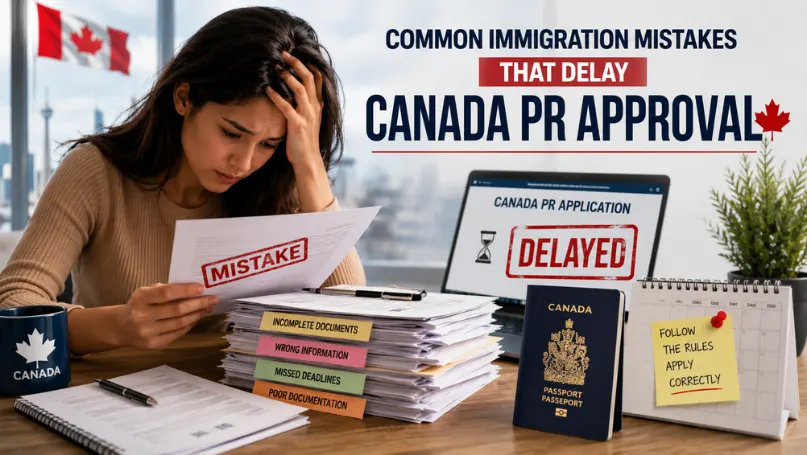
There are thousands of Canada PR applications that are delayed every year because of avoidable mistakes that could have been made before the applications were submitted. Common problems that can cause delays in applications submitted to an experienced Immigration Lawyer in Calgary include NOC codes that are filled out incorrectly, missing supporting documents, discrepancies in employment history, and incorrect data on the Express Entry profile.
Immigration officers check all claims and paperwork, so any minor error may result in further inquiries and clarifications. This guide will reveal the most frequent errors that cause delays in Canada PR and how they can be avoided by following the tips trusted by a Top Immigration Law Firm in Calgary.
Understanding Canada PR Processing Stages: Where Delays Typically Occur
There are several stages in the Canada PR application process before the IRCC finally decides on the application. There can be delays at any stage if further verification or clarification is needed. Each applicant knows these stages and takes positive steps to ensure that they are not set back again as a result of not preparing their application accordingly, so many decide to hire an Immigration Lawyer in Calgary to guide them through the process.
Stage 1: Completeness Check
IRCC first checks to see if all the necessary forms and fees have been submitted properly, and to determine if all supporting documents have been submitted properly.
Stage 2: Eligibility Verification
Applicants’ work experience, education, language skills, and other eligibility factors are evaluated to ensure they meet the requirements for the program they selected for immigration.
Stage 3: Medical, Criminality, and Security Screening
Tests of the medical condition, police statements and background checks are done to establish entry to Canada.
Stage 4: The applicant will undergo a final examination and decision
IRCC makes a final check at the end of the process to make sure all requirements are in place prior to approval. A lot of applicants are looking for assistance from the Top Immigration Law Firm in Calgary to ensure that the process will run smoothly.
Common Immigration Mistakes
Mistake #1: Choosing the Wrong NOC Code
Many applicants choose their NOC based on job titles, but IRCC evaluates the duties performed, not the designation on a business card. If your job role is not closely aligned with your chosen NOC, it might not be recognized and you may face further scrutiny or need to provide more documentation. A seasoned Immigration Lawyer Calgary can evaluate if your duties are suitable for the appropriate NOC before submitting.
Mistake #2: Submitting Incomplete Supporting Documents
The issue isn’t a missing document, it’s an incomplete document that can cause just as much damage. Delays are often caused by employment letters which don’t include job responsibilities or salary information, out-of-date police certificates, lack of financial proof, missing educational documents, or lack of translations that are certified or notarized. Document preparation is one of the most important areas of the PR process as IRCC officers evaluate the quality and presence of documents.
Mistake #3: Claiming CRS Points Without Proper Evidence
There are many delays because those applying try to earn CRS points and are unable to substantiate them. IRCC thoroughly checks foreign and Canadian work experience, language test validity, and educational qualifications and spouse-related points.
Officers are not obliged to accept the score claimed unless supporting evidence exists to support it, in which case they will be able to recalculate eligibility, and/or seek clarification, which may impact the invitation to apply and the application may be delayed.
Mistake #4: Failing to Update Your Express Entry Profile
An Express Entry profile is not a “one-time submission”; it is a living application that must be updated to reflect current circumstances.
Eligibility and/or CRS scores can be affected by marriage, a different job, a child, or a new passport. If these are not reported, it can lead to inconsistencies that will draw extra attention during IRCC’s review.
Mistake #5: Inconsistent Employment History
One of the initial places IRCC checks for inconsistencies in employment records. A resume that lacks explanations for missing work time or overlapping jobs, or a resume that lists an employer that doesn’t reference the applicant, or a resume with discrepancies between the resume and a reference letter can cause credibility doubts. Clear explanations and consistency throughout all documents enable officers to cross-check your experience faster and with less length of review.
Mistake #6: Misrepresentation – Even Honest Mistakes Can Cause Serious Delays
Misrepresentation can take place even by mistake. If you fail to reveal a previous visa rejection, a criminal charge, a prior marriage or a dependent family member, then you might be subject to a long investigation and a fairness review.
IRCC wants full disclosure even if the information that is left out seems trivial. Several applicants turn to an Immigration Lawyer in Calgary for guidance in an effort to prevent disclosures that will cost them dearly.
Mistake #7: Ignoring Additional Document Requests (ADR)
An Additional Document Request usually indicates that IRCC requires more clarity in making a decision. Often, requests are for updated proof of funds, employment history, travel history, or identity documents. Failure to meet the deadlines for submission of information, or incomplete applications, may result in an application being considered “extended review,” thus increasing processing times by weeks or months.
Mistake #8: Underestimating Medical and Background Verification
When a person submits his/her application, many applicants assume that the application is fast-tracked and the medical, criminality, and security verification is finished, but this is not always the case. A long time can be extended in case of extensive travelling, living in several countries or further security checks. By consulting with a Top Immigration Law Firm in Calgary, applicants can make sure that they have the required documents ready before they even begin to apply and prevent any delays when reviewing the application.
What Is a Procedural Fairness Letter (PFL)?
A Procedural Fairness Letter (PFL) is issued when IRCC identifies concerns that could affect a Canada PR application, such as discrepancies in work experience, possible misrepresentation, or insufficient supporting evidence.
The applicants usually have a restricted time to reply, and a full and comprehensive explanation is required. A PFL is usually the last chance to respond to IRCC’s concerns before an application is denied, and many applicants want to learn how to best prepare their response with the help of an experienced Immigration Lawyer in Calgary or a top immigration law firm in Calgary.
Canada PR Application Checklist Before Submission
Check that you have chosen the right NOC Code.
- Make sure that every claimed CRS point is backed up by evidence.
- Submit relevant Police Clearance Certificates (PCCs).
- Check employment reference letters for correctness and thoroughness.
- Provide copies of documents in a language other than English or French that have been certified as a translation.
- Verify passport is current and in order.
- Take any necessary medical tests, if needed.
- Obtain proof of funds that meets the IRCC requirements.
How an Immigration Lawyer in Calgary Can Help Avoid Costly Delays?
Simple mistakes can result in further reviews, further requests for documents and a slow processing time. By collaborating with an experienced Immigration Lawyer in Calgary, applicants can enhance their applications, preemptively tackle any issues, and move through the process with greater confidence. Here’s how:
1. Legal Review
Detecting errors, inconsistencies and possible red flags prior to submission.
2. Evidence Verification
Making sure that employment documentation, proof of funding and any supporting documents comply with IRCC requirements.
3. PFL Response Support
Effectively responding to Procedural Fairness Letters (PFLs) and responding to IRCC concerns.
4. Appeals and Complex Cases
Advice on refusals, inadmissibility and other complex immigration issues.
5. Strategic Immigration Advice
The right immigration strategy is crucial and could prevent unnecessary delays in the application process, and a Calgary Top Immigration Law Firm can assist applicants with the selection of the appropriate strategy.
Conclusion
Canada PR delays are often caused by preventable mistakes rather than eligibility issues. From incorrect NOC selection to incomplete documentation and missed updates, even small errors can significantly impact processing timelines.
Taking the time to review your application carefully can save months of uncertainty and frustration. If you want experienced legal guidance throughout the process, OB Law Office can help you navigate complex immigration requirements, strengthen your application, and respond effectively to challenges before they become costly delays.