
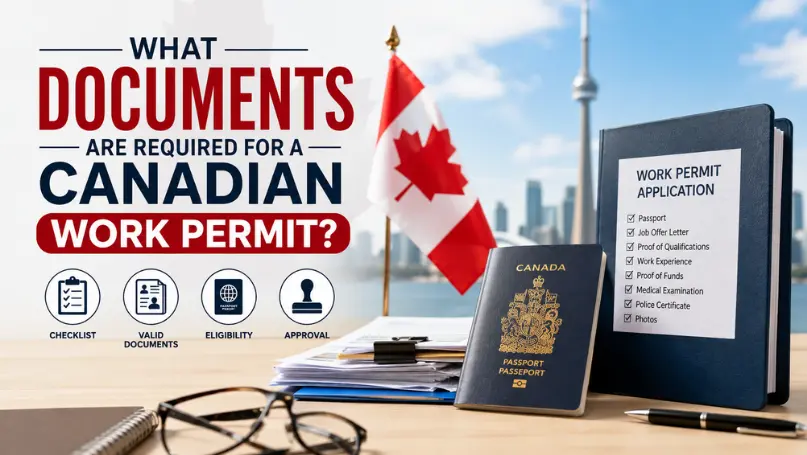
A work permit application is only as convincing as the documents that back up the information you’re providing. Which documents you require will depend on your job offer, employment history, qualifications, LMIA status, immigration history, and where you apply for your job offer. For example, an LMIA-based application may require employer-specific evidence that an open work permit applicant would not.
This guide details what you might need for your Canadian work permit, what each document is evidence of, and which documents you will need to check to avoid incomplete or inconsistent submissions, with the assistance of a Work Permits & Visa Lawyer in Calgary as necessary.
What Determines Which Documents You Need?
There isn’t a single checklist that everyone who applies for a Canadian work permit will follow. Documents required depend on the type of permit you are applying for and the reasons for your permit application. Prior to the collection of paperwork, consider these factors:
- Type of work permit: Evidence required for different types of work permits.
- LMIA status: For an LMIA-based application, a positive LMIA and relevant employment documents may be required; for an LMIA-exempt application, proof of exemption and an Offer of Employment (OE) number will be required.
- Requirements may vary depending on where an application is made.
- Where you apply: Supporting documents required may vary depending on your circumstances, including: previous immigration status, work history, family situation, occupation and medical or background requirements.
- Personalized IRCC checklist: A document checklist is generated by your application which contains all the information you provide. This is where you should begin instead of using a list that you find online.
Visa Lawyer Calgary can assist you in working out the proper process and determining if your supporting documents correspond to the application when there is no clarity.
Canadian Work Permit Documents at a Glance
Canadian Work Permit Documents at a Glance
The required documents vary by permit type. This table gives a quick overview before you check your personalized IRCC checklist.
| Work Permit Type | Key Documents |
| Employer-Specific | Job offer, contract, experience proof |
| LMIA-Based | LMIA, job offer, contract |
| LMIA-Exempt | Contract, Offer of Employment number |
| Open Work Permit | Eligibility proof, category documents |
| Additional Requirements | Medical, police certificate, biometrics, translations |
Common Documents You May Need
It is important that your Canadian work permit documents establish your identity, eligibility, employment and admissibility. Requirements vary based on the application, but are generally:
- Passport or travel document: Proves identity and nationality.
- Forms for application: Give general information about your job, immigration and personal details.
- Photographs: Must conform to the requirements of IRCC.
- Proof of status: Evidence of immigration status when applying within Canada.
- Employment documents: This may include a Job offer, Contract, LMIA or Offer of Employment number.
- Work experience: Reference letters or work records can help with work experience.
- Education: Degrees, diplomas, licences or certificates as appropriate.
- Medical examination: Applicants may be required to undergo by circumstances.
- Police certificates: May be needed for admissibility checks.
- Biometrics: If applicable to your application.
- Translation: This usually means compliant translations in the documents’ language other than English or French.
Documents for an Employer-Specific Work Permit
An employer-specific work permit is normally linked to the employer, job, and conditions outlined in the work permit application. The supporting documents should thus provide a coherent and positive impression of the employment being sought and the applicant’s capabilities.
Job Offer and Employment Contract
You might be required to have a written job offer or employment contract with specific details, including job title, work, salary, working conditions, etc., depending on the work permit pathway. Applications based on LMIA could need the LMIA documentation.
Work Experience and Reference Letters
If you have experience that is relevant to the position, you can include an employment letter or other record to show that. The information should be accurate, relating to your employer, position, dates of employment, and responsibilities.
Education & Professional Credentials
When relevant to the job or a specific work permit category or occupation, supply degrees or diplomas, licences, certificates or other credentials.
The information is presented in a two-part format: Resumé and Supporting Evidence.
Your CV is supposed to accurately document your education and work experience and must not contradict your application and supporting documents. Job titles, employment dates, employer names and job duties should be consistent throughout. Where there is an actual difference, e.g. formal job title versus internal title, it’s best to explain the difference than leave an apparent one unaddressed.
LMIA-Based vs. LMIA-Exempt Work Permits
The key difference is why the job qualifies for a Canadian work permit. This helps to determine if the position requires a Labour Market Impact Assessment (LMIA) or if it is exempt from having an LMIA.
LMIA-Based Applications
Typically, a Labour Market Impact Assessment (LMIA) will be needed when the employer has to establish that foreign worker hiring satisfies the relevant labour market criteria. A positive LMIA, LMIA number, job offer and employment contract might be included in the application. In the applicable Quebec cases, a Quebec Acceptance Certificate (CAQ) may also be required.
LMIA-Exempt Applications
If the job is an LMIA-exempt work permit, the work does not require an LMIA since it meets a specific exemption. The employer will usually provide the required information via the Employer Portal and will give an Offer of Employment number. The applicant shall also furnish proof in support of the specific exemption.
There are a lot of differences in the documentation for each category, which is why a Calgary Work Permits & Visa Lawyer can help ensure that the documentation is applicable to the pathway for the work permit.
LMIA-Based vs. LMIA-Exempt Work Permits
The key difference is whether the job requires a Labour Market Impact Assessment (LMIA). The documentation and eligibility requirements change depending on the pathway.
| Aspect | LMIA-Based | LMIA-Exempt |
| LMIA | Generally required | Not required |
| Employer process | LMIA application | Employer Portal submission |
| Key reference | LMIA number | Offer of Employment number |
| Supporting evidence | LMIA, job offer, contract | Contract, exemption evidence |
| Eligibility basis | Positive LMIA | Specific exemption category |
What Documents Are Required for an Open Work Permit?
Unlike an employer-specific permit, an open work permit generally does not require a job offer or Labour Market Impact Assessment (LMIA). Instead, applicants need to prove that they qualify under the particular open-work-permit category.
Common documents may include:
- Proof of eligibility: Evidence showing you meet the requirements of your specific open work permit category.
- Current immigration status: Relevant documents if applying from inside Canada.
- Relationship documents: Marriage, partnership, or family documents where eligibility depends on a relationship.
- Category-specific evidence: Documents supporting the particular program or circumstance that makes you eligible.
- Medical or police documents: Provided when required based on your circumstances.
Medical Exams, Police Certificates and Biometrics
Not every Canadian work permit applicant will need all three. A medical examination may be required depending on factors such as the type of work, intended stay, and medical-admissibility rules. Police certificates may be requested to assess admissibility based on your personal circumstances and travel or residence history. Biometrics may also be required depending on your nationality and application history. Rather than assuming these documents apply to everyone, check the requirements generated for your specific application by IRCC.
Do Canadian Work Permit Documents Need Translation?
In most cases, documents submitted to IRCC are required to satisfy the translation requirements applicable to that document if it is not submitted in English or French. Translation should be complete and accurate; names, dates, stamps etc. should correspond with the original. Applicants are also advised to check to see if the original documents, certificate, or translator requirements apply. A competent Calgary Work Permits & Visa Lawyer will be able to look at translated documents and check for inconsistencies or missing information prior to submission.
How a Work Permits & Visa Lawyer in Calgary Can Help?
A Work Permits & Visa Lawyer in Calgary can provide a structured review of your application, including:
- Figure out the correct route: LMIA-based, LMIA-exempt, employer-specific, or open.
- Review document requirements: Review the customized IRCC document checklist and pathway-specific document requirements.
- Check supporting information: Employment letters, qualifications, job offers and employer documents.
- Look for consistency: Match names, dates, job responsibilities, work experience, and other important information on documents.
- Identify missing documents/explanation: If applicable, assist in determining missing documents or explanations.
- Final application review: Make sure the supporting documents are complete, relevant and well organized before submission.
Conclusion
A Canadian work permit application is not a document collection exercise; it’s about providing the right evidence for the right pathway. What you need will depend on your LMIA status, employment information, qualifications, immigration history, and individual factors.
Checking documents for completeness and consistency before submission can avoid some of the problems. OB Law Office is a Calgary Work Permits & Visa Lawyer that can assist you in evaluating your application.